

The Faith That Unites: A Concise Exploration of Pure Monotheism
A Straightforward Guide to Monotheism
Azher Hameed Qamar
ISBN: 9798284304136
Dedicated to TRUTH and PEACE
FOREWORD
‘Oneness’ is not shared — belief in one God means belief in His absolute, indivisible unity.
Throughout history, God sent many prophets to guide humanity, all delivering the same essential message: the belief in the absolute oneness of God. From the earliest messengers to the final Prophet Muhammad (peace be upon him), this core teaching remained unchanged. They all called people to worship God alone, without associating anything or anyone with Him. No object, person, or symbol was to be equated with or placed alongside God in His divinity, authority or worship.
Two fundamental principles were at the heart of every prophet’s message. First, that God is one and utterly unique—He has no partners, no equals, and no likeness. Second, that human beings are meant to have a direct and personal connection with their Creator. Worship, prayers, and supplications are to be directed solely to God, without the need for any intermediaries such as prophets, saints, priests, or religious/spiritual leaders. The relationship between a person and God was never meant to be mediated by others—it was, and always is, direct and personal.
However, over time, the clarity of this original message became clouded. Today, the majority of the world identifies—at least in name—with either Christianity or Islam. But despite this widespread association with monotheistic faiths, many religious practices across different communities include the involvement of intermediaries—such as prophets, saints, or clergy—as a means of connecting with God. This shift away from direct worship can largely be attributed to historical misinterpretations, deliberate distortions, or the blending of religious teachings with cultural traditions, known as cultural syncretism. As a result, the pure concept of monotheism was altered in some traditions, and the direct relationship between the individual and God was weakened or even restricted.
The true message brought by all prophets, however, remains consistent and unchanged: that God is one, without partners, and that every human being has the right—and responsibility—to turn to Him directly, in worship, prayer, and devotion.
INTRODUCTION
Faith has long been a force that unites people across cultures and civilizations, offering meaning, purpose, and a shared sense of belonging. Among the many beliefs that have shaped human history, pure monotheism stands as a timeless and universal truth—one that transcends divisions and calls humanity toward the recognition of a single, all-powerful Creator. This book, The Faith that Unites: A Concise Exploration of Pure Monotheism, brings to light the core principles of monotheism as understood in the three Abrahamic faiths—Judaism, Christianity, and Islam. The Torah, the Gospel, and the Quran all share the fundamental belief in one, singular God. This common ground between Judaism, Christianity, and Islam serves as a powerful reminder that, despite differences in doctrine and practice, their foundational teachings stem from the same divine truth.
Islam is the last of the Abrahamic religions and is believed by Muslims to complete God’s message through the Qur’an. The Qur’an is considered the final holy book after the Zaboor, Torah, and Gospel, and Muslims believe it is the exact word of God (Allah). It continues the teachings of earlier scriptures, including the Torah and the Gospel. A key belief in Islam is that all prophets sent by God must be accepted, including Moses (Musa), Jesus (Isa), and the last prophet, Muhammad (peace be upon them all). Without this belief in God’s continuous guidance, a person cannot be a Muslim. According to Quran, Jesus (peace be upon him) was not crucified or killed but was miraculously raised to the heavens by God.
“And [for] their saying, “Indeed, we have killed the Messiah, Jesus, the son of Mary, the messenger of Allah.” And they did not kill him, nor did they crucify him; but [another] was made to resemble him to them. And indeed, those who differ over it are in doubt about it. They have no knowledge of it except the following of assumption. And they did not kill him, for certain. Rather, Allah raised him to Himself. And ever is Allah Exalted in Might and Wise.” (Qur’an Chapter 4 Verses 157-158)
Islamic teachings say that Jesus is still alive and will return to Earth near the end of time to bring justice and teach people to worship only one God. At that time, Muslims will follow Jesus as a righteous leader and servant of Allah.
Focusing on the shared values and beliefs among Abrahamic religions can be a good starting point for peace, acceptance, and reconciliation. For example, the belief that Jesus will return and that they should follow him can help billions of people live together in peace by respecting and accepting each other, even if they have differences in other beliefs. Similarly, the Qur’an encourages dialogue and unity by focusing on the shared belief in one God. Quran promotes discussion and bring people together based on their common faith in God’s oneness. Instead of pointing out differences, it calls for agreement on worshiping only Allah, which was also taught in earlier scriptures.
“O People of the Scripture, come to a word that is equitable between us and you – that we will not worship except Allah and not associate anything with Him and not take one another as lords instead of Allah.” (Quran Chapter 3 Verse 64)”
In this context, along with the Quran, I believe the Ten Commandments are an important document that not only describe monotheism but also unite the Abrahamic religions through a shared belief in one God. They are a set of biblical laws that God gave to Moses on Mount Sinai, recorded in the Book of Exodus and the Book of Deuteronomy in the Old Testament. The first two commandments emphasize that anyone who believes in or claims to follow monotheism must truly uphold and practice it.
You shall not have the gods of others in My presence. You shall not make for yourself a graven image or any likeness which is in the heavens above, which is on the earth below, or which is in the water beneath the earth. You shall neither prostrate yourself before them nor worship them. (Exodus 20:3-5)
By acknowledging and respecting these shared beliefs, followers of these faiths can foster greater understanding, unity, and dialogue in an increasingly divided world. Monotheism remains the cornerstone of faith for billions, guiding them toward devotion, righteousness, and submission to the one true God. By exploring the fundamental belief in one God, this book highlights the unity at the heart of these traditions, revealing how faith in a singular Creator provides not only spiritual clarity but also a foundation for moral and social harmony. This chapter delves into the rational and spiritual basis for believing in one God, drawing upon both the natural world and sacred teachings to demonstrate the undeniable signs of divine existence and the profound impact of true monotheism on human life.
The Perfect Order of the Universe: A Testament to One Creator
The universe is a vast and complex expanse that defies human comprehension. Despite our scientific advancements, our knowledge remains but a fraction of what truly exists. Our Earth, which we often perceive as the center of our reality, is nothing more than a tiny drop in the boundless ocean of the cosmos. The brevity and mortality of human life remind us of our transient existence, as everything around us is subject to the inevitable passage of time.
Scientific discoveries continue to reveal the enormity of the universe. The observable universe is estimated to be about 93 billion light-years in diameter, containing approximately 2 trillion galaxies. Astronomers and physicists have identified black holes, dark matter, and countless celestial phenomena, yet the full extent of the cosmos remains a mystery. One undeniable fact, however, is that the universe operates in perfect harmony. The precise forces of gravity maintain the delicate balance of celestial bodies, ensuring stability. Even a slight deviation in these forces could lead to catastrophic consequences. For instance, if the Earth were to stop rotating for even a second, the resulting chaos would be unimaginable.
Our solar system is a remarkable example of this intricate balance. Each planet, moon, and celestial object follows a precise defined path, governed by gravitational forces that keep everything in order. The Sun’s gravitational pull ensures that planets remain in their orbits, preventing disorder. A minor alteration in this cosmic equilibrium could result in the destruction of entire systems.
Such perfect order and control point to the existence of a singular authority—God. The seamless functioning of the universe suggests the presence of an intelligent creator with complete knowledge and control over this vast system. If multiple gods existed, each with competing authority, the universe would be unstable and vulnerable to chaos. Instead, its flawless operation supports the idea of one supreme being orchestrating everything.
The human body further reinforces this notion. The complexity of our senses, neural networks, organs, bones, and joints is extraordinary. The heart pumps blood through billions of veins and arteries, the digestive system processes nutrients with efficiency, and the brain coordinates countless functions with remarkable precision. This intricate design could not have come into existence by mere chance. If multiple creators were responsible, the lack of coordination would lead to dysfunction and disorder. The seamless harmony within the human body is further evidence of a single, intelligent designer.
In conclusion, the universe’s vastness and complexity, along with the perfect order governing celestial bodies, serve as powerful evidence of a singular, omniscient creator. The delicate balance of gravitational forces, the orderly movement of planets, and the harmonious functioning of the human body all point to one supreme authority—God. As scientific discoveries continue to unveil the wonders of the cosmos and life itself, they only reinforce the fundamental truth that a divine presence maintains order, harmony, and existence in the universe. We cannot define God, his existence is beyond any definition. As rabbi Aron Moss says:
“The definition of God is: “a Being without definition.” God cannot be defined, because if I define Him then I limit Him. And something limited is not God. The Creator doesn’t have a definition. That’s what makes Him God. And that’s why there can be only one.” (Moss, n.d.)
His presence is revealed through His creations. Anything we can define is confined by the boundaries of our understanding and imagination. While we acknowledge the limitations of our knowledge and the immeasurable depth of what remains unknown, we should reflect on God’s creations. Through this thoughtfulness, we can begin to grasp the unparalleled power and authority of God—the Creator—who maintains harmony in all things. The Quran contains numerous verses that encourage humans to reflect on the world around them as signs of God’s existence and greatness. For example:
(If they want a sign for the perception of this Reality) surely there are countless signs for those who use their common sense; they can see alternation of the night and day, in the ships that sail the ocean laden with cargoes beneficial to mankind, and in the rain-water which Allah sends down from the sky and thereby gives life to the earth after its death and spreads over it all kinds of animate creatures, in the blowing of the winds and in the clouds which obediently wait for orders between the sky and the earth. (Quran 2:164)
And of His Signs is the creation of the heavens and the earth and the diversity of your tongues and colours. Indeed there are Signs in this for the wise.And of His signs is your sleep by night and day and your seeking of His bounty. Indeed in that are signs for a people who listen. And of His Signs is that He shows you lightning, arousing both fear and hope, and sends down water from the sky and revives the earth after it is dead. Indeed there are Signs in this for those who use their reason. And of His Signs is that the sky and the earth stand firm by His command. Then no sooner than He summons you out of the earth you will come forth. (Quran 30:22-25)
The Quran also beautifully narrates the story of Prophet Abraham (Ibrahim, peace be upon him) as he reflects on the universe to understand and recognize the true Creator.
And [mention, O Muhammad], when Abraham said to his father Azar, “Do you take idols as deities? Indeed, I see you and your people to be in manifest error. And thus did We show Abraham the realm of the heavens and the earth that he would be among the certain [in faith]. So when the night covered him [with darkness], he saw a star. He said, “This is my lord.” But when it set, he said, “I like not those that disappear. And when he saw the moon rising, he said, “This is my lord.” But when it set, he said, “Unless my Lord guides me, I will surely be among the people gone astray. And when he saw the sun rising, he said, “This is my lord; this is greater.” But when it set, he said, “O my people, indeed I am free from what you associate with Allah. Indeed, I have turned my face toward He who created the heavens and the earth, inclining toward truth, and I am not of those who associate others with Allah. (Quran 6:74-79)
The Bible is relatively silent on the early life of Abraham’s life, but important details are provided by the Midrash and Talmud, and it says (see Posner, n.d.):
The world continued in this fashion until the pillar of the world — the Patriarch Abraham — was born. He began to explore and think. He began to think incessantly throughout the day and night, wondering: How is it possible for the sphere to continue to revolve without having anyone controlling it? Who is causing it to revolve? Surely, it does not cause itself to revolve. He had no teacher, nor was there anyone to inform him. His father, mother, and all the people around him were idol worshipers, and he would worship with them. However, his heart was exploring and gaining understanding. Ultimately, he appreciated the way of truth and understood the path of righteousness through his accurate comprehension. He realized that there was one God who controlled the sphere, that He created everything, and that there is no other God among all the other entities. He knew that the entire world was making a mistake. What caused them to err was their service of the stars and images, which made them lose awareness of the truth. (Posner, n.d.)
The story of Abraham imparts a timeless lesson on understanding the oneness of God. It teaches us that recognizing God as the unique, singular Creator does not require elaborate proofs or intermediaries; rather, it calls for sincere contemplation and reflection on His creations. Through the natural wonders, the intricate balance of the universe, and the beauty of life, we find undeniable evidence of His unmatched power and divine authority. When we engage in free and profound thinking—unhindered by preconceived notions—it becomes evident that God is unlike anything within the realm of creation. He transcends all limitations and characteristics associated with being created. Thus, He cannot be represented or worshiped in any form that imitates His creation, nor can He be confined to any tangible attribute of existence. This understanding leads to the thoughtful and fundamental realization that God is truly one, absolutely incomparable and beyond all human imagination. Abraham’s journey inspires us to use reason and reflection to appreciate this truth. It encourages a deeper exploration of faith by observing the signs around us and arriving at the certainty of God’s oneness through thoughtful introspection.
Monotheism, the belief in the existence of one God, has evolved over centuries through various religious traditions, including Judaism, Christianity, and Islam. The Abrahamic religions believe that Adam and Eve were the first humans created by God. Their story also marks the start of belief in one God. In Islam, the Quran says that all human souls promised to believe in one God when they were created. According to Islamic teachings, this means that belief in one God is deeply ingrained in human nature (fitrah).
“And [mention] when your Lord took from the children of Adam – from their loins – their descendants and made them testify of themselves, [saying to them], “Am I not your Lord?” They said, “Yes, we have testified.” [This] – lest you should say on the day of Resurrection, “Indeed, we were of this unaware. (Quran 7:172)”
The story of Abraham, as outlined above, offers valuable insights into the historical development of monotheism. Abraham’s journey marks a pivotal moment in religious history, as he becomes a central figure in establishing the belief in one supreme God. His rejection of idolatry and polytheistic practices reflects a profound transformation in human understanding of the divine.
BELIEF IN ONE GOD
Many religions affirm the belief in one God, but I have come to see this belief as more than just a religious doctrine—it is a profound truth that has the power to unite us as human beings and liberate us from dependence on worldly sources that can never truly fulfill our deepest needs. In times of difficulty or helplessness, people often turn to spiritual leaders, saints, graves, statues, or other created beings, hoping for miracles or assistance—mistakenly attributing to them powers that belong to God alone. However, if we reflect deeply, we realize that these objects and beings—no matter how revered—do not meet the true definition of a God. A God who is a Creator and who has always existed, who was never created, and who can never be created. In my view, the most fundamental truth we must recognize is the identity of the true Creator—one who has never been created and who alone possesses absolute power and authority over all existence. Understanding and believing in this Creator’s limitless knowledge, wisdom, and ability to fulfill the needs of His creation is essential to developing a pure and unwavering faith.
This belief strengthens us in two profound ways. First, it liberates us from submitting—whether openly or subtly—to any created being, ensuring that our connection to the Creator remains direct and untainted by intermediaries. By acknowledging that only God holds ultimate power, we free ourselves from misplaced dependency on worldly figures or objects. Second, it brings tranquility to both our material and spiritual lives. When we live with the awareness that our dignity is a divine gift—bestowed upon humanity as the noblest of all creation—we learn to navigate this worldly life with honor, self-respect, and an unshakable sense of purpose.
True faith in the Creator not only aligns our hearts with the truth but also empowers us to live with clarity, confidence, and peace, knowing that we are under the care of the One who is eternal, all-knowing, and ever-merciful.
To believe in one God is to declare the truth that this God must be absolutely unique and self-sufficient. This uniqueness is not just a symbolic or metaphorical concept—it is an absolute reality. God cannot be compared to anything in creation or imagined in any created form, whether human, angelic, or material like a statue or an idol. Any attempt to liken God to creation diminishes the very essence of divine uniqueness. True monotheism requires that we understand God beyond human limitations and beyond the physical world we perceive.
This realization has been a journey for me—one that has shaped my understanding of what it truly means to believe in one God. Throughout my life, I’ve felt a deep connection to one God—through prayer and through the understanding that we, as human beings, are part of a beautiful and purposeful creation. This sense of wonder has led me to see God as a loving Creator. Through reflection, spiritual seeking, and a desire to understand the meaning behind life and existence, I’ve come to recognize certain core characteristics of pure monotheism—truths that point to the oneness of God.
These characteristics are not merely philosophical ideas; they are the foundation of a faith that transcends human limitations and unites all who sincerely seek the truth about One God. When we embrace this understanding, it transforms the way we see the world and our place in it. We are no longer bound by superstitions or the need to seek favor from powerless intermediaries. Instead, we connect directly with the One who is eternal, self-sufficient, and the ultimate source of all help, guidance, and mercy. This belief is not just about theology—it is about freedom, clarity, and the realization of a higher purpose.
Therefore, when I seek to understand the concept of One God, I focus on three essential characteristics that define His divinity—qualities that make Him the one and only God, worthy of worship, devotion, and absolute obedience.
The Core Principles of Pure Monotheism
In my journey to understand the concept of One God, I have identified three fundamental characteristics that define His divinity. These attributes distinguish the true Creator from all created beings and establish why He alone is worthy of worship, prayer, and obedience.
1. God is One
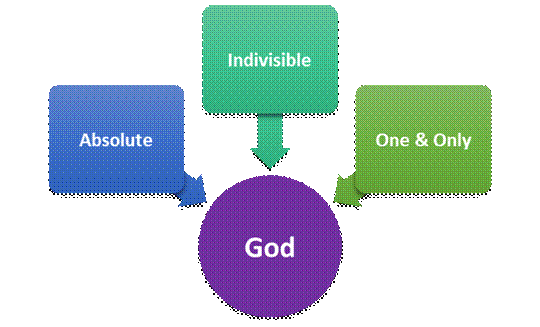
When we say “God is One”, we are not referring to a numerical value that defines quantity. Rather, we mean that God is “One and Only”—a singular, indivisible being who has no equal, no partner, no assistant, and no rival. He is unmatched in His existence, power, and authority. His Oneness is absolute, meaning He is not part of a duality, a trinity, or any form of multiplicity. When I reflect on the statement “God is One”, I understand it as a declaration that He is the only true divine being, without comparison or division.
2. God is Unique
The uniqueness of God is unlike the uniqueness we sometimes attribute to His creation. For example, Prophet Adam (peace be upon him) was unique because he was created without parents. Similarly, Prophet Jesus (peace be upon him) was unique because he was born without a father. However, despite these extraordinary circumstances (and eminence), they remain created beings—humans with a beginning and an end. Their uniqueness does not make them divine.
When we say “God is Unique”, we mean that He is absolutely and infinitely distinct from anything in existence. His uniqueness is not just about being different; it is about being beyond comparison. He cannot be replicated, imagined, formed, reincarnated, or represented in any physical or conceptual form. He is entirely beyond human perception and comprehension, existing beyond time, space, and matter. This uniqueness reinforces that God is self-sufficient and independent of all creation.
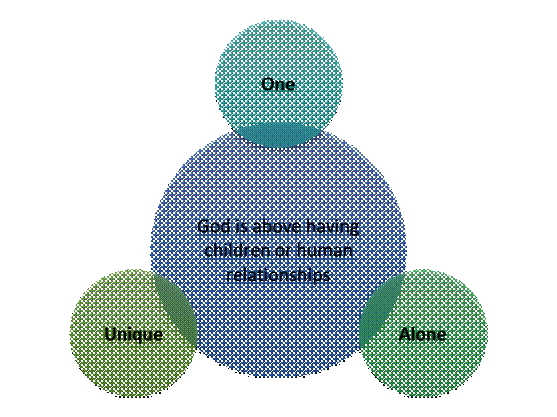
3. God is Above Having Children or Procreating
The first two characteristics—God’s Oneness and Uniqueness—are unanimously accepted by monotheistic followers of the Abrahamic faiths (Judaism, Christianity, and Islam). These principles naturally lead to the understanding that the One, Unique God is beyond the need to have children or offspring. Associating anyone—even the most revered angels or prophets—as God’s (begotten) children contradicts His absolute Oneness and is incompatible with pure monotheism.
God is not like His creation, and He does not function in ways that are bound by human experiences, such as reproduction. Assigning human-like attributes to God diminishes His divine nature and places limitations on His absolute uniqueness and power. True monotheism requires recognizing that God is far above any human relationships, including fatherhood or procreation.
Breaking the Barriers to a Direct Connection with God
In my honest understanding, these three key characteristics form the foundation of pure monotheism. However, when I look around, I often see that even those who consider themselves monotheists—Muslims, Christians, and Jews—sometimes turn to objects or human figures (whether living or deceased) in their quest for divine help. This raises an important question: What prevents them from seeking God directly—the One and Only, the Unmatched and Self-Sufficient? Perhaps the greatest obstacle is the weight of tradition—the deeply ingrained customs set by some saints, preachers, spiritual leaders, and ancestors. Whether intentionally or unintentionally, they introduced the idea of intermediaries between human beings and their Creator. Over time, these intermediaries became an accepted norm, forming a barrier between people and their direct relationship with God.
While I cannot explore every historical or theological detail in this short book, it is important to note that the scriptures of the Abrahamic faiths clearly emphasize God’s absolute Oneness and Uniqueness. Nowhere in these divine texts do we find prophets claiming divinity for themselves or demanding worship alongside God. Instead, they consistently directed people toward the pure worship of the One True Creator, without partners, images, or mediators.
A Simple and Direct Path to Pure Monotheism
The purpose of this book is to compile essential knowledge from these scriptures that illuminate the Oneness and Uniqueness of God. My aim is to present a simple, direct, and clear understanding of what it means to be a true monotheist—one who worships God alone, without any association or intermediary. The path to pure monotheism is not complicated. It requires only sincerity, reflection, and the courage to break free from traditions that may have distanced us from the Creator. It is an invitation to return to the fundamental truth: “God is One, God is Unique, and God is beyond all human limitations.” This belief is not just a theological concept—it is a profound source of strength, peace, and purpose in life. When we embrace it wholeheartedly, we free ourselves from unnecessary dependencies and find a direct connection with the One who created us, sustains us, and guides us with unmatched wisdom and mercy.
I believe that when we remove the need for intermediaries in our connection with the one true God, our faith will grow stronger, and we will come together as human beings with a shared purpose. The prophets taught that we should have a direct relationship with God, just as they did. Their central message was always the oneness of God. If any prophet were to claim to be God or a part of Him—whether as a begotten child or an incarnation—it would go against this core message. That is why no holy scripture contains a verse where a prophet declares himself to be God or equal to Him. Instead, every prophet introduced himself as a messenger of God, calling people to worship Him alone.
True monotheism has the potential to dissolve the divisions that arise from sectarianism and conflicting religious interpretations, allowing us to focus our collective energy on serving humanity. When our faith-based institutions shift their priorities from exclusivity and division to inclusivity and service, they can become powerful forces for social good. Instead of being preoccupied with religious differences, they can work toward alleviating suffering, fostering compassion, and addressing pressing global challenges.
Belief in One God provides a spiritual foundation that strengthens our inner resolve, encouraging us to redirect our energy toward solving real-world problems rather than fragmenting ourselves into religious sects. It teaches us that all human beings are part of a single creation and that our shared responsibility is to uplift one another. Whether it is poverty, injustice, environmental crises, or social inequalities, a united faith-driven effort can be a force for meaningful change. By embracing the essence of monotheism—absolute devotion to the One Creator without division or intermediaries—we cultivate a mindset that values unity over discord and action over empty rhetoric. This belief, when internalized and practiced, does not detach us from worldly responsibilities; rather, it empowers us to address them with renewed purpose, sincerity, and collective strength.
MONOTHEISM IN JUDAISM
Monotheism—the belief in one, singular, all-powerful God—is the foundation of Judaism and is deeply rooted in the Torah. The Torah – including the books of the Hebrew Bible (Genesis, Exodus, Leviticus, Numbers, and Deuteronomy), repeatedly affirms that there is only one God who is the Creator, Sustainer, and Lawgiver of the universe. The Torah begins with the affirmation that there is only one Creator of the universe:
“In the beginning, God created the heavens and the earth.” (Genesis 1:1)
This verse, along with the following ones, underscores the essential belief that God is the sole Creator of everything. In contrast to polytheistic traditions that ascribe various elements of the universe to different deities, the Torah emphasizes that all of existence is brought into being by one divine entity. Throughout Genesis, God’s creative acts demonstrate His supreme authority over the cosmos, reinforcing the monotheistic worldview. There is no mention of competing gods or divine beings assisting in creation—only one sovereign God.
The Shema: The Declaration of Monotheism
One of the most fundamental declarations of God’s oneness in the Torah is found in the Shema prayer in Deuteronomy 6:4:
“Hear, O Israel: The Lord our God, the Lord is one.” (Deuteronomy 6:4)
This verse, known as the Shema Yisrael, is the cornerstone of Jewish faith and daily prayer. The Shema is a central proclamation of faith in Judaism, emphasizing the oneness of God. Regarded as the most significant Jewish prayer, it is recited daily in both morning and evening prayers. As a fundamental expression of monotheism and devotion to God, it comprises three key passages: the core declaration of God’s oneness (Deuteronomy 6:4-8), the blessings of obedience and the consequences of disobedience (Deuteronomy 11:13-21), and a reminder of God’s commandments (Numbers 15:37-41). It explicitly states that God is one, rejecting the idea of multiple deities. The Shema emphasizes that God is unique, indivisible, and sovereign over all creation (Chabad.org, n.d). Judaism teaches that God is one, exists without question, and created everything. God has no body, is neither male nor female, and cannot be divided into parts. He is everywhere, knows everything, and has unlimited power, but He gives people free will. God is both fair and kind, balancing justice with mercy. He is eternal, meaning He has no beginning or end. In Judaism, God is seen as a loving parent to all people (Mechon Mamre, n.d.).
The development of monotheism in Judaism is a significant milestone in religious history. The Hebrew Bible (Old Testament) documents the transition from polytheism to monotheism among the Israelites. Key figures such as Abraham, Moses, and the prophets played crucial roles in this transformation.
Abraham (Ibrahim – peace be upon him) is considered the patriarch of Judaism (and father of the prophets). His covenant with God marked the beginning of a monotheistic tradition. According to Genesis 12:1-3, God promised Abraham that his descendants would become a great nation if they remained faithful to Him.
“Now the LORD said to Abram, “Go from your country and your kindred and your father’s house to the land that I will show you. And I will make of you a great nation, and I will bless you and make your name great, so that you will be a blessing. I will bless those who bless you, and him who dishonors you I will curse, and in you all the families of the earth shall be blessed.” (Genesis 12:1-3)
Abraham preaches the oneness of God through his covenantal relationship, his rejection of idolatry, and his exemplary faith and obedience.These actions serve as a cornerstone for the development of monotheistic faiths. Through the covenant with Abraham, the Torah reinforces that there is only one true God who establishes moral and spiritual guidance for humanity. That one true God will be the God of all the generations afterwards (Genesis 17:1-9).
Moses (peace be upon him) is another important prophet of God in the development of monotheism. He led the Israelites out of Egypt and was entrusted by God with the Ten Commandments on Mount Sinai. The first two commandments highlighted the importance of worshiping only the one true God and strictly prohibited attributing divine status to anything or anyone else, whether in form or essence.
“You shall have no other gods before me. You shall not make for yourself a carved image, or any likeness of anything that is in heaven above, or that is in the earth beneath, or that is in the water under the earth.” (Exodus 20:3-4)
This commandment explicitly forbids the worship of any other deities, reinforcing that God alone is to be worshiped. The Torah consistently warns against idolatry, as seen in Leviticus 19:4:
“Do not turn to idols or make for yourselves any gods of cast metal: I am the LORD your God.” (Leviticus 19:4)
Before his passing, Moses reaffirmed the centrality of monotheism to the Israelites. he declares:
“To you it was shown, that you might know that the LORD is God; there is no other besides him.” (Deuteronomy 4:35)
And again in Deuteronomy 4:39:
“know therefore today, and lay it to your heart, that the LORD is God in heaven above and on the earth beneath; there is no other.” (Deuteronomy 4:39)
These verses leave no ambiguity—there is only one God, and He alone is sovereign over all creation.
In continuity, the prophets, including Isaiah, Jeremiah, and Ezekiel, reinforced the idea of monotheism by condemning idolatry and urging the Israelites to remain faithful to God. For example:
“Thus says the LORD, the King of Israel and his Redeemer, the LORD of hosts: “I am the first and I am the last; besides me there is no god”.” (Isaiah 44:6)
“But the LORD is the true God; he is the living God and the everlasting King. At his wrath the earth quakes, and the nations cannot endure his indignation.” (Jeremiah 10:10)
“For behold, he who forms the mountains and creates the wind, and declares to man what is his thought, who makes the morning darkness, and treads on the heights of the earth– the LORD, the God of hosts, is his name!” (Amos 4:13)
The development of monotheism in Judaism marked a fundamental shift from polytheistic traditions to the exclusive worship of one God. Abraham’s covenant with God established the foundation of monotheistic faith, emphasizing loyalty and rejection of idolatry. Moses reinforced this belief by delivering the Ten Commandments, which explicitly commanded the Israelites to worship only one God and reject any form of idol worship. Prophets like Isaiah, Jeremiah, and Ezekiel further solidified monotheism by declaring God’s uniqueness and condemning idolatry. This unwavering belief in one God became the cornerstone of Jewish identity and influenced other Abrahamic religions.
MONOTHEISM IN CHRISTIANITY
The life and teachings of Jesus Christ are foundational to Christianity. Jesus Christ continued preaching oneness of God, affirming the (Shema) monotheistic belief of Judaism. For example:
“And one of the scribes came up and heard them disputing with one another, and seeing that he answered them well, asked him, “Which commandment is the most important of all? Jesus answered, “The most important is, ‘Hear, O Israel: The Lord our God, the Lord is one. And you shall love the Lord your God with all your heart and with all your soul and with all your mind and with all your strength. The second is this: ‘You shall love your neighbor as yourself.’ There is no other commandment greater than these.” (Mark 12:28-31):
“Teacher, which is the great commandment in the Law? And he said to him, “You shall love the Lord your God with all your heart and with all your soul and with all your mind. This is the great and first commandment.” (Matthew 22:36-38)
“And behold, a lawyer stood up to put him to the test, saying, “Teacher, what shall I do to inherit eternal life? He said to him, “What is written in the Law? How do you read it? And he answered, “You shall love the Lord your God with all your heart and with all your soul and with all your strength and with all your mind, and your neighbor as yourself. And he said to him, “You have answered correctly; do this, and you will live.” (Luke 10:25-28)
The Shema remains a cornerstone of Jewish faith, and Jesus explicitly affirms it in the Gospels, highlighting its importance in loving and serving God. He does not present himself as divine but instead points to the singular sovereignty of God, just as taught in Jewish tradition. The belief in one God is central to the teachings of Jesus Christ and the message found in the Gospels. Throughout his ministry, Jesus repeatedly emphasized the oneness of God, aligning with the core teachings of Judaism and the Torah. Contrary to later theological interpretations that deified Jesus, the Gospels present him as a messenger of God who called people to worship the one true God. The Bible contains verses where Jesus emphasizes his role as a servant of God and his dependence on the God Almighty, that is an indications of his distinction from God. For example, in John 17:3 Jesus speaks about eternal life and the knowledge of God.
And this is eternal life, that they know you the only true God, and Jesus Christ whom you have sent. (John 17:3)
Jesus’ teachings consistently direct worship and devotion to God alone. In Matthew 4:10, when Satan tempts him, Jesus responds:
“And he said to him, ‘All these I will give you, if you will fall down and worship me.’ Then Jesus said to him, ‘Be gone, Satan! For it is written,’ You shall worship the Lord your God and him only shall you serve.’” (Matthew 4:9-10)
Jesus makes it clear that worship belongs to God alone, without intermediaries or partners. Similarly, in John 4:23, Jesus teaches about true worship:
“But the hour is coming, and is now here, when the true worshipers will worship the Father in spirit and truth, for the Father is seeking such people to worship him.” (John 4:23)
Jesus does not instruct people to worship him; instead, he points them toward the Father (and it means a loving creator and Lord, not a physical father), reinforcing monotheism.
This verse highlights the importance of knowing and understanding God as the one true deity and recognizing Jesus Christ as His messenger. It emphasizes a deep, personal relationship with God and acknowledges His role in granting eternal life.
Another verse highlights the Jesus Christ as a man blessed with miracles and wonders with the permission of one God.
“Men of Israel, hear these words: Jesus of Nazareth, a man attested to you by God with mighty works and wonders and signs that God did through him in your midst, as you yourselves know.” (ACTS 2:22)
Jesus distinguishes himself from God
Throughout the Gospels, Jesus makes a clear distinction between himself and God, affirming that he is not divine but rather a servant of God.
And this is eternal life, that they know you the only true God, and Jesus Christ whom you have sent. (John 17:3)
You have heard Me tell you, ‘I am going away and I am coming to you.’ If you loved Me, you would have rejoiced that I am going to the Father, because the Father is greater than I. … [I am going away] so that the world may know that I love the Father. Just as the Father commanded Me, so I do. (John 14:28,31)
In Luke 18:18-19, when a rich man asks Jesus about eternal life, Jesus directs him to God alone:
“And a ruler asked him, “Good Teacher, what must I do to inherit eternal life? And Jesus said to him, “Why do you call me good? No one is good except God alone.” (Luke 18:18-19)
Jesus makes a profound distinction between himself and God, attributing absolute goodness only to God. He also distinguishes himself from God by declaring his limited knowledge and God as all-knowing. Jesus acknowledges that he does not possess all knowledge, which further differentiates him from God. In Mark 13:32, he says:
“But concerning that day or that hour, no one knows, not even the angels in heaven, nor the Son, but only the Father.” (Mark 13:32)
If Jesus were divine, he would have knowledge of all things. Yet, he clearly states that only the Father has ultimate knowledge, reaffirming that God alone possesses absolute wisdom and authority.
He speaks about his role as a messenger of God and his dependence on God’s will.
“I can do nothing on my own. As I hear, I judge, and my judgment is just, because I seek not my own will but the will of him who sent me.” (John 5:30)
“And Jesus said to him, ‘Why do you call me good? No one is good except God alone’”. (Mark 10:18)
“Jesus said to her, “Do not cling to me, for I have not yet ascended to the Father; but go to my brothers and say to them, ‘I am ascending to my Father and your Father, to my God and your God.’” (John 20:17)
These verses provide profound insights into the nature and relationship of Jesus Christ with God, emphasizing the existence of God as the one true, supreme Creator. They highlight Jesus’ humility, dependence on God, and unwavering commitment to fulfilling God’s will. Jesus frequently refers to God as “Father,” underscoring a spiritual bond rather than a biological connection. This term reflects an intimate, reverent relationship with God—a relationship grounded in trust, obedience, and divine guidance.
Jesus’ reference to God as “Father” is akin to the way humans often describe themselves as “children of God,” signifying their connection to Him as their Creator and Sustainer. For example, when Jesus says, “my Father and your Father, my God and your God,” he bridges the relationship between humanity and God, inviting people to recognize their shared dependence on the one true God. It illustrates the inclusivity of the divine relationship, showing that God is not only Jesus’ God but also the God of all believers.
Similarly, by saying that the Father is greater than him, Jesus acknowledges his subordinate role to God, reinforcing that only God is supreme. Jesus also practiced this in his prayer that is a significant indication that Jesus is not divine. In Matthew 26:39, before his crucifixion, Jesus prays:
“And going a little farther he fell on his face and prayed, saying, “My Father, if it be possible, let this cup pass from me; nevertheless, not as I will, but as you will.” (Matthew 26:39)
By praying to God and submitting to His will, Jesus shows that he is dependent on God. If Jesus were God, he would not need to pray or seek divine intervention.
By emphasizing this spiritual connection, these verses remind us that God transcends human attributes and limitations. He is not bound by physical forms or relationships. Instead, He is the eternal Creator who is above all creation. Jesus’ teachings reinforce the belief in God’s unique and unmatched sovereignty, inspiring believers to reflect on their own relationship with the divine and their role in living according to His will.
The concept of the Trinity, which describes God as three persons in one—Father, Son, and Holy Spirit—is more of a historical development within Christianity than a message directly based on revealed texts. Many verses in the Bible, along with other scriptures, suggest that Jesus never claimed to be God or any form of God. If he had, it would have been contrary to Shema, the teachings of earlier prophets, the commandments given to Moses, and the foundational principles found in revealed texts like the Torah, the Gospel, and the Quran. For example, verses in the Old and New Testaments emphasize the oneness of God and portray Jesus as devoted to doing the will of God rather than presenting himself as divine. These scriptures align with the teachings of all prophets, who consistently affirmed the belief in one, unique God.
The Trinity, however, appears to have taken shape as a doctrine over the course of Christian history. This development seems to have been influenced by theological debates, evolving interpretations of scripture, and the sociopolitical context in which Christianity grew, particularly when it became the official religion of the Roman Empire. During this period, beliefs about Jesus being the “begotten Son of God” or even God himself were shaped by interpretations that may have been influenced by the cultural and political climate of the time.
It’s important to note that such interpretations, which later solidified into doctrines, might reflect misunderstandings or misinterpretations of earlier teachings. These interpretations were shaped by the historical, social, and cultural needs of the early Christian communities, as well as their interactions with the Roman state and the broader world. This is why concepts like the Trinity may be viewed as theological constructs rather than the original, core message of the revealed texts. While these interpretations of Christianity introduced doctrines such as the Trinity, the direct words of Jesus in the Gospels align with monotheistic teachings found in the Torah and the Quran.
MONOTHEISM IN ISLAM
Islam is one of the major monotheistic religions, emphasizing the absolute oneness of God. Muslims believe in all prophets as messenger of one and only God. Prophet Muhammad (peace be upon him) is the last prophet in a long line of prophets who preached monotheism, including Abraham, Moses, and Jesus Christ. They all shared the same core message: the worship of one true God. Prophet Abraham (peace be upon him) had two sons: Ishmael (Isma’il) and Isaac (Ishaq). Prophet Muhammad is a direct descendant of Ishmael, whereas Moses and Jesus are from the line of Isaac. Muhammad is seen as the “Seal of the Prophets” (Khatam an-Nabiyyin), completing the divine guidance that began with earlier prophets.
The Quran, is the final revelation of God, following the previous scriptures such as the Zabur (Psalms), Torah, and Injeel (Gospel). It serves as a comprehensive guide, leaving no ambiguity regarding the concept of monotheism. The Quran explicitly and unequivocally affirms the belief in one God (Allah) while rejecting all forms of polytheism. This central message is reinforced throughout its 114 chapters in various ways. To illustrate the Quran’s clarity on monotheism, I will present two key passages: Ayat al-Kursi (The Throne Verse, Quran 2:255) and Surah Al-Ikhlas (Quran 112). These passages powerfully emphasize the uniqueness, sovereignty, and absolute oneness of God, leaving no room for misinterpretation.
“Allah – there is no deity except Him, the Ever-Living, the Sustainer of [all] existence. Neither drowsiness overtakes Him nor sleep. To Him belongs whatever is in the heavens and whatever is on the earth. Who is it that can intercede with Him except by His permission? He knows what is [presently] before them and what will be after them, and they encompass not a thing of His knowledge except for what He wills. His Kingdom extends over the heavens and the earth, and their preservation tires Him not. And He is the Most High, the Most Great.” (Quran 2:255)
“In the name of Allah, the Entirely Merciful, the Especially Merciful. Say, “He is Allah, [who is] One and Unique;Allah, Who is in need of none and of Whom all are in need; He neither begot any nor was He begotten, and none is comparable (or any equivalent) to Him.” (Quran 114:1-4)
The Quran clearly emphasizes the absolute oneness, uniqueness, and greatness of Allah. He is the only true God, ever-living and sustaining all existence without fatigue or need for rest. Everything in the heavens and the earth belongs to Him, and nothing happens without His permission. He has complete knowledge and control over all things, yet His creation cannot fully comprehend Him. He is One and has no equal, no partner, no children, and no dependence on anyone, while all of creation depends on Him. There is nothing like Him, making Him the Most High, the Greatest, and the only One worthy of worship.
Jesus Christ and Oneness of God: Quranic Perspective
In the Qur’an, Jesus Christ—known in Arabic as ‘Isa (peace be upon him)—is described as one of the most honored and revered prophets in Islam. He holds a uniquely respected position among the prophets, and his life is presented as a series of miraculous events, all by the will and power of Allah.
The Qur’an makes it clear that Jesus was not divine, nor the son of God, but rather a noble messenger sent by Allah to guide the Children of Israel back to the worship of the one true God. He, like all the prophets before him, came with a message of pure monotheism (Tawhid)—to worship Allah alone without any partners.
“˹Jesus also declared,˺ “Surely Allah is my Lord and your Lord, so worship Him ˹alone˺. This is the Straight Path.”(Quran 19:36)
This verse captures the essence of Jesus’s message in the Qur’an. He did not call people to worship himself, his mother Mary (Maryam), or anyone else, but directed all worship to Allah alone. The Qur’an rejects any claims of his divinity or that of anyone else besides God.
The Qur’an also speaks of the miraculous birth of Jesus, emphasizing that it was a sign of Allah’s power and will. He was born to the Virgin Mary, a pious and chosen woman, without any human intervention—a miracle ordained by God. Mary’s role is deeply respected in Islam. She is regarded as one of the most righteous women to ever live. The Qur’an even names an entire chapter after her, Surah Maryam. In addition to his miraculous birth, Jesus was granted extraordinary miracles by Allah’s permission. These were signs to his people of his truthfulness and his status as a prophet—not acts of independent divine power.
“Mary wondered, My Lord! How can I have a child when no man has ever touched me?” An angel replied, “So will it be. Allah creates what He wills. When He decrees a matter, He simply tells it, ‘Be!’ And it is! And Allah will teach him writing and wisdom, the Torah and the Gospel, and ˹make him˺ a messenger to the Children of Israel ˹to proclaim,.. ‘I have come to you with a sign from your Lord: I will make for you a bird from clay, breathe into it, and it will become a ˹real˺ bird—by Allah’s Will. I will heal the blind and the leper and raise the dead to life—by Allah’s Will. And I will prophesize what you eat and store in your houses. Surely in this is a sign for you if you ˹truly˺ believe.”(Quran 3:47-49)
These miracles clearly point to the power and will of Allah, not the divinity of Jesus. The Qur’an consistently reminds its readers that Jesus never claimed to be divine, and that such beliefs arose later, diverging from his actual teachings.
“And ˹on Judgment Day˺ Allah will say, “O Jesus, son of Mary! Did you ever ask the people to worship you and your mother as gods besides Allah?” He will answer, “Glory be to You! How could I ever say what I had no right to say? If I had said such a thing, you would have certainly known it. You know what is ˹hidden˺ within me, but I do not know what is within You. Indeed, You ˹alone˺ are the Knower of all unseen.I never told them anything except what You ordered me to say: “Worship Allah—my Lord and your Lord!” And I was witness over them as long as I remained among them. But when You took me, You were the Witness over them—and You are a Witness over all things.”(Quran 5:116–117)
Thus, in the Qur’an, Jesus (peace be upon him) is honored not as a deity, but as a devout servant and messenger of Allah who called for the worship of the one true God. His life, teachings, and miracles all serve to reaffirm the message of monotheism, consistent with the missions of all the prophets before him.
The Qur’an makes it abundantly clear that extraordinary miracles, remarkable births, or great worldly power—no matter how astonishing—do not grant anyone divinity or a status beyond that of a servant and prophet of Allah. These miracles and blessings were signs from God, meant to affirm the truth of His messengers and guide people to worship Him alone, not to elevate the prophets themselves to divine status.
Take the example of Prophet Jesus (peace be upon him). He was born miraculously, without a father—a sign of God’s power. Yet, the Qur’an emphasizes that this miraculous birth does not make him divine.
“Indeed, the example of Jesus in the sight of Allah is like that of Adam. He created him from dust, then said to him, “Be!” And he was! This is the truth from your Lord, so do not be one of those who doubt.”(Quran 3:59-60)
This verse draws a direct comparison between Jesus and Prophet Adam (peace be upon him), who was created without a father or mother. If miraculous origin were a basis for divinity, then Adam would be more deserving of that claim—but he too was simply a servant and prophet of Allah.
Similarly, Prophets Moses (Musa) and Jesus (Isa) were both granted incredible miracles: Moses parted the sea, his staff turned into a serpent, and he brought down the Torah. Jesus healed the blind and lepers, raised the dead, and spoke as an infant. Yet none of these miracles made them anything more than chosen prophets of God.
“Indeed, We gave Moses the Book and sent after him successive messengers. And We gave Jesus, son of Mary, clear proofs and supported him with the holy spirit.” (Quran 2:87)
Moreover, the Qur’an also mentions prophets who were blessed with power and authority, such as Prophet David (Dawud) and his son Prophet Solomon (Sulaiman). Solomon was given control over the wind, could understand the speech of animals, and had dominion over the jinn. Despite such power, they remained humble servants of Allah, never claiming divinity, nor were they ever presented by the Qur’an as anything other than prophets.
“Indeed, We granted knowledge to David and Solomon. And they said ˹in acknowledgment˺, “All praise is for Allah Who has privileged us over many of His faithful servants…And David was succeeded by Solomon, who said, “O people! We have been taught the language of birds, and been given everything ˹we need˺. This is indeed a great privilege…Solomon’s forces of jinn, humans, and birds were rallied for him, perfectly organized.”(Quran 27:16)
“And We blessed David with Solomon—what an excellent servant ˹he was˺! Indeed, he ˹constantly˺ turned ˹to Allah.”(Quran 38:30)
These examples serve a clear purpose: to remind humanity that all power, knowledge, and miracles originate from Allah alone. The prophets were honored and beloved by God, but they were still His servants—completely dependent on His will. The Qur’an consistently reinforces that none of these prophets shared in God’s divinity, nor were they ever meant to be objects of worship.
“Say, ˹O Prophet,˺ “I am only a man like you, ˹but˺ it has been revealed to me that your God is only One God. So whoever hopes for the meeting with their Lord, let them do good deeds and associate none in the worship of their Lord.”(Quran 18:110)
Thus, the message of the Qur’an is firm and clear: miraculous events, noble status, or worldly dominion do not elevate anyone to divine status. All prophets, from Adam to Muhammad (peace be upon them all), were sent to guide people to the worship of the one true God—Allah—without partners, intermediaries, or equals.
CONCLUSIONS
Although the Quran, Bible, and Old Testament belong to distinct religious traditions, they share a common emphasis on the oneness of God. Each scripture upholds monotheism as a core belief, rejecting polytheism and any association of partners with God. These sacred texts consistently affirm God’s singularity, serving as a continual reminder of His exclusive divinity. Throughout history, prophets have denounced idolatry and reinforced the worship of one true God.
Islam, Christianity, and Judaism share key aspects of God’s nature that reinforce their monotheistic foundations. They all affirm that God is one, all-powerful, and all-knowing. He is just, merciful, and compassionate, and believers are called to strengthen their personal, direct relationship with Him through devoted worship as the one and only God.
The idea of believing in only one God has a long and interesting history that goes back thousands of years and appears in different religions. Monotheism became well-established in faiths like Judaism, Christianity, and Islam, growing over time through the teachings of important religious figures, sacred scriptures, and deep discussions about God’s nature. By learning about this history, we can better understand the common beliefs and differences between these major religions. True monotheism means that God is completely unique, has no equal, and does not need to take any physical form to prove that He exists. If God were like anything in creation or needed a form to be known, He would not be truly God.
Lesson Learnt from Torah, Gospel, and Quran
Despite the historical and doctrinal differences among Judaism, Christianity, and Islam, the core teaching of monotheism remains consistent across their scriptures. Based on the teachings of the Torah, the Gospel, and the Quran, the belief in one true God is central to monotheistic faiths. Understanding the characteristics of God helps clarify why only one God exists and why nothing else can be divine.
God is One – There is no god/s but only one God
“Hear, O Israel: The LORD our God, the LORD is one” (Deuteronomy 6:4)
“The most important is, ‘Hear, O Israel: The Lord our God, the Lord is one.’” (Mark 12:29)
“Say, He is Allah, [who is] One.” (Quran 112:1)
God Alone is to Be Worshiped – Worshiping anything or anyone other than God is strictly prohibited
“You shall have no other gods besides Me. You shall not make for yourself a carved image, or any likeness of anything that is in heaven above, or that is in the earth beneath, or that is in the water under the earth” (Exodus 20:3-4)
“Then Jesus said to him, “Be gone, Satan! For it is written, “‘You shall worship the Lord your God and him only shall you serve.” (Matthew 4:10)
“Had there been within the heavens and earth gods besides Allah, they both would have been ruined. So exalted is Allah, Lord of the Throne, above what they describe. There is no deity except Me, so worship Me.” (Quran 21:22,25)
God Has No Partners or Offspring – God is unique and does not share His divinity. He is eternal and self-sufficient.
“I am the first and I am the last; besides me there is no god” – “I am the LORD, and there is no other, besides me there is no God.”(Isaiah 44:6 – Isaiah 45:5)
“And this is eternal life, that they know you the only true God” (John 17:3)
“Allah, the Eternal Refuge. He neither begets nor is born.” (Quran 112:2-3)
“They say: “The Most Compassionate Lord has taken to Himself a son.” Glory be to Him! Those whom they so designate are only His honoured servants.” (Quran 21:26)
The Torah, the Gospel, and the Quran collectively affirm the oneness, eternity, and transcendence of God, who is beyond any human limitations. They highlight Him as the sole Creator, the ultimate sustainer, and the only being truly worthy of worship. Recognizing these divine attributes illuminates why nothing else—be it human or resembling divine qualities—can be equated with God (Genesis 1:1; Numbers 23:19; Quran 42:11; John 1:18; Quran 6:103; Isaiah 40:28; Quran 2:255; Psalm 147:5; Quran 6:59; Genesis 18:14; Quran 2:20). Embracing these truths enables individuals to foster a clearer and deeper understanding of God, strengthening their faith in the One who is truly incomparable.
Bibliography
Chabad.org. . (n.d.). The Complete Jewish Bible with Rashi Commentary. Retrieved [14 March 2025], from https://www.chabad.org/library/bible_cdo/aid/63255/jewish/The-Bible-with-Rashi.htm
Mechon Mamre. (n.d.). God in Judaism. Retrieved [10 March 2025], from https://mechon-mamre.org/jewfaq/god.htm
Moss, A. (n.d.). Is there a logical proof that there’s only one God? Retrieved March 22, 2025, from https://www.chabad.org/library/article_cdo/aid/160960/jewish/Is-There-a-Logical-Proof-that-theres-only-One-G-d.htm
Posner, M. (n.d.). The story of Abraham in the Bible: The first patriarch. Retrieved March 22, 2025, from https://www.chabad.org/library/article_cdo/aid/112356/jewish/The-Story-of-Abraham-in-the-Bible.htm#Abrahams The Noble Quran. (n.d.). Quran.com. https://quran.com/